medium
Marble
Marble gives a maker one attempt. Nothing goes back on, and every decision stays visible in the finished stone, which is why the house treats a carved piece as the clearest evidence of skill it can hold.
Subtraction has no undo
A bronze can be re-modelled in wax until the maker is satisfied. A cast can be pulled again if it fails. Carving offers neither. The maker removes stone until the form appears, and a cut that goes too deep ends the piece. Months of work can be lost in a second of inattention at a thin passage.
This is why carving time is measured in months rather than weeks, and why the house treats a finished carved work as unique by definition. There is no edition, no second cast, and no way to produce another that is the same.
The house checks the block before the carving
Before looking at what a maker did, the house looks at what they did it to:
- One block, no joins. A join at the neck or ankle is the usual way a broken carving gets rescued, and it changes what the work is.
- No filler at the thin points. Wax and stone dust packed into a bad cut will read under angled light and will fail over time.
- No dye. Marble is dyed to hide a vein a maker did not want. The house would rather see the vein.
Then it looks at the difficult passages, where the stone runs against the form. A vein crossing a shoulder at the wrong angle is where skill shows, because the maker has to carve with the material and not against it.
Reading a carved surface
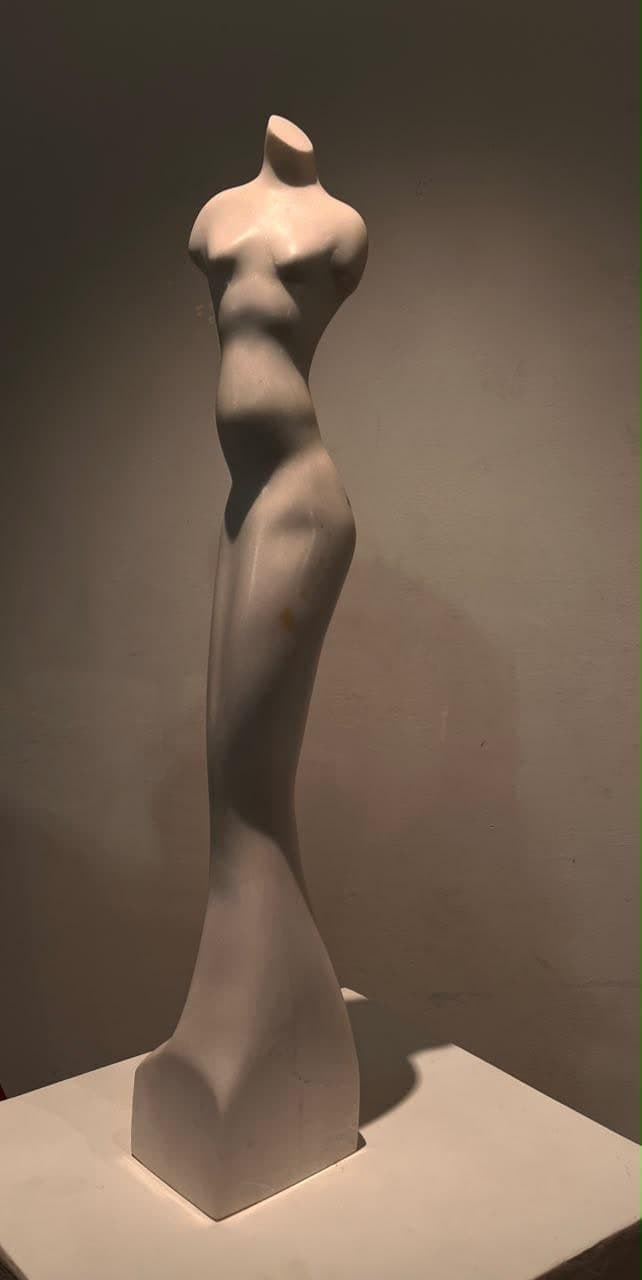
Polish is a decision, not a finish. A high polish makes marble read as skin and hides tool marks. A softer sheen keeps the sense of the stone. Many makers work both into one piece, polishing the form and leaving the base rough so the body appears to rise out of the block it came from, which is what happens in The Long Turn.
Look at the piece from the side before the front. A carved torso is a three-dimensional argument about balance, and a maker who has only resolved the front view gives themselves away the moment you walk around it.
What the certificate records
For a carved work the Mount Qaf Certificate records the stone, the dimensions, the date, and the appraised value, and notes that the work is unique. Because there is no edition to reference, the record and the object are the only evidence there is, which makes the certificate matter more here than anywhere else in the house.