Kiln-Cast Glass, Explained
Cast glass is the least forgiving material the house handles, and the reason has nothing to do with carving skill. It is arithmetic about heat.
How a cast is made
The maker builds a model, usually in wax or clay, and takes a refractory mould from it. The mould goes into a kiln with glass above or inside it. The kiln takes the glass past its melting point so it flows into every part of the mould, then begins to cool.
That cooling is the work. Glass has no melting point in the way ice does; it thickens gradually through a range. Somewhere in that range it stops flowing and starts behaving like a solid, and if different parts of the mass cross that threshold at different times, the piece locks permanent stress into itself.
Why annealing decides everything
Annealing is the slow, controlled hold that lets the whole mass pass through that range together. The thicker the piece, the longer it takes, and the relationship is not linear. Doubling the thickness can quadruple the time.
A large cast can spend two weeks in a kiln nobody is allowed to open. Opening it early, or dropping the temperature faster than the schedule allows, produces a piece that looks perfect and then cracks. Sometimes on the bench. Sometimes months later in a collector’s house, which is the outcome that ends reputations.
This is why a large cast glass work is expensive in a way that surprises people. You are paying for kiln time, for the schedule, and for every earlier attempt that did not survive it.
What to look for
- Cold seams. Where two flows of glass met and failed to fuse, a faint line shows under raking light. It never comes out and it is a structural weakness, not a cosmetic one.
- Stress. Invisible to the eye, visible under polarised light as coloured fringes. Any serious seller should be willing to say whether a piece has been checked.
- Surface intent. Mould texture left on the glass should be a decision the maker can explain. So should a high polish.
- Inclusions. Bubbles and veils are part of casting. They should be recorded rather than denied.
Living with it
Glass changes more than any other material through the day. A piece reads dense at midday and hollow at dusk, and the same work looks different against a window than against a wall. Give it light that moves rather than a single fixed lamp.
It is heavier than it looks. Cast glass wants a surface that will not flex, and cast textures hold dust, which is a property of the material rather than a fault in the object.
In the house
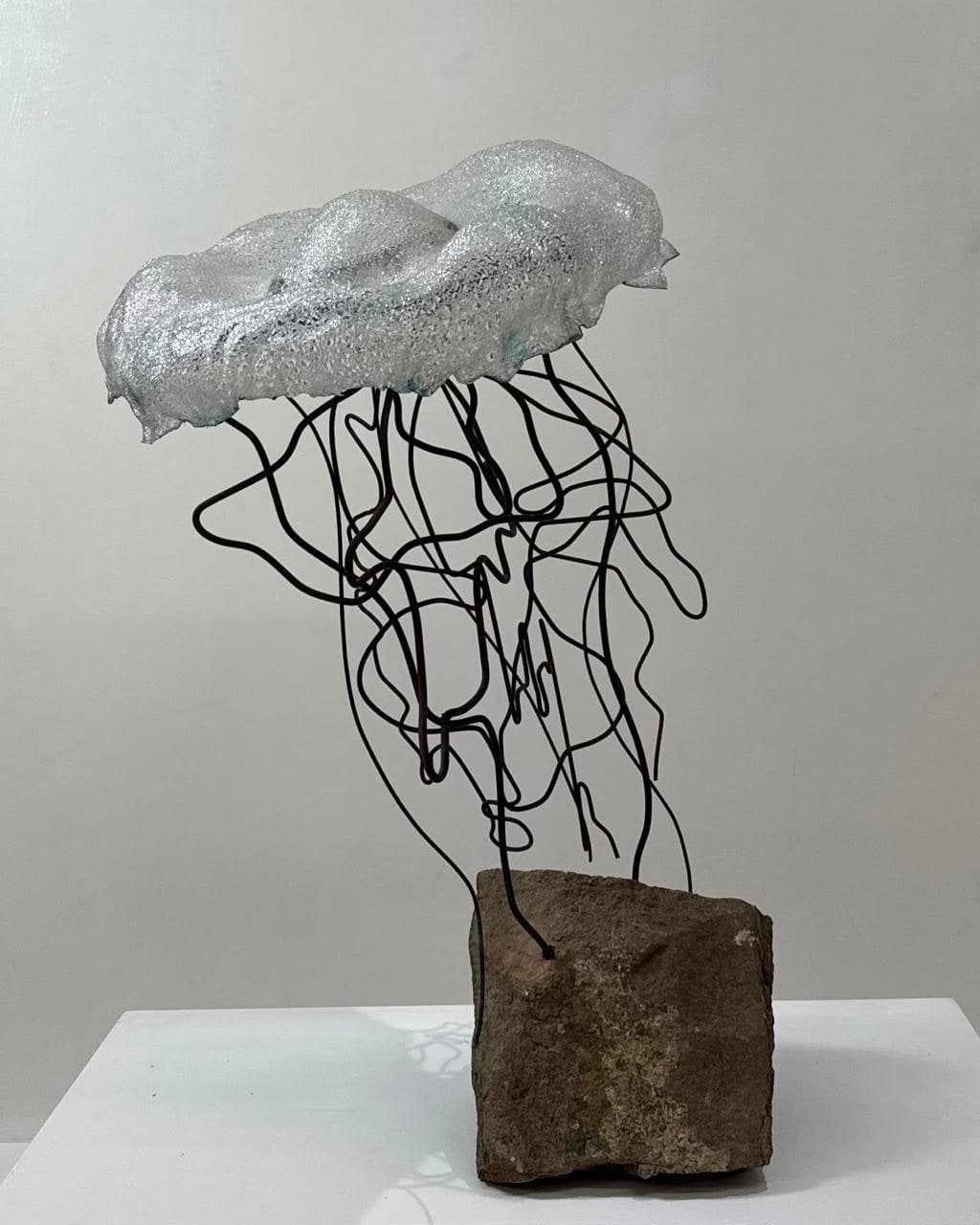
Floating Jelly is a kiln-cast bell hung on hand-bent steel above a salvaged sandstone block. The maker left the mould texture on the glass, which is why light entering the lobed top scatters before it reaches the underside. The rest of the glass collection sets out what the house checks before accepting a cast.