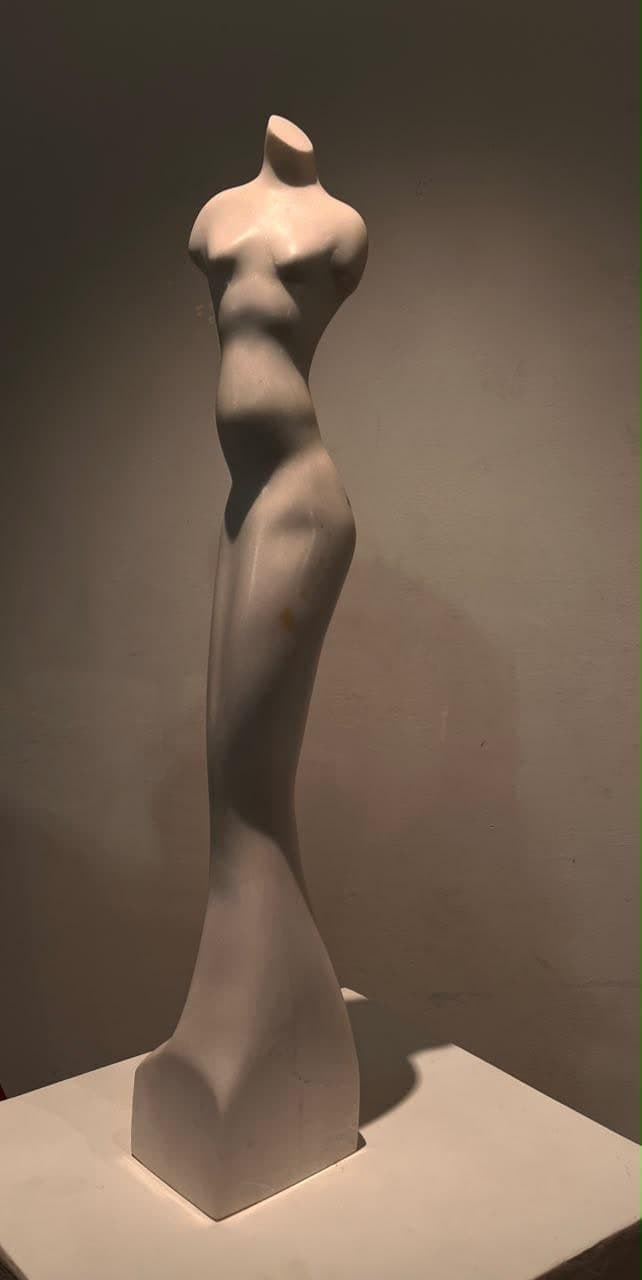
Carving Marble, and How to Spot Machine Work
Marble is the material where the phrase hand-carved does the most work and gets the least scrutiny. A buyer can usually tell a cast bronze from a resin copy by picking it up. Telling a carved marble from a machine-roughed one takes knowing where to look.
How a carving is made
The maker starts with a block and removes everything that is not the work. Roughing out takes the bulk away with a point chisel, then a claw chisel brings the form closer, then flat chisels, rasps and rifflers refine it, and abrasives finish it. A high polish is the last decision rather than an inevitable one.
The order matters because it is one-directional. There is no stage at which material can be put back, which is why a carved work takes months and why a mistake at a thin passage can end the piece. The Long Turn took eleven months and came out of a single block.
The machine is older than you think
Mechanical assistance in marble is not a modern scandal. The pointing machine, a frame that transfers measured points from a plaster model to a block, has been standard since the eighteenth century. Canova and Thorvaldsen ran workshops where assistants roughed out with points and the master finished. Rodin rarely touched marble himself.
So machine involvement does not automatically mean deception. What matters is what a seller says about it. A workshop that describes its process honestly is in a long tradition. A seller who implies one pair of hands did everything, when a robot did the first eighty per cent, is selling you a different object from the one you think you are buying.
What CNC changed
Modern practice goes further than pointing. A model is 3D scanned, a multi-axis mill roughs the block, and a carver finishes the surface by hand. The result can be very good, and for architectural work it is entirely sensible.
It changes two things for a collector. The work becomes reproducible, because the file can be milled again into another block. And the hours that justified the price move from the carver to the machine. Neither is fraud. Both are things you should know before agreeing a figure, and both bear on how the piece should be appraised.
What to look for
- Tool marks in the unfinished areas. Hand roughing leaves irregular, varied bites. Milling leaves consistent stepping or a regular sweeping pattern, often visible on the underside or inside a recess where nobody bothered to sand.
- Deep undercuts. A place where the form curls back on itself is awkward for a mill and straightforward for a carver with a riffler. Their presence is a good sign.
- Symmetry that is too clean. Hand carving carries small asymmetries. A face where both sides match to the millimetre was measured by something that does not get tired.
- The back and the base. This is where a piece finished to photograph well gives itself away, whoever or whatever roughed it.
- The block itself. Look for joins at the neck or ankle, filler at thin points, and dye covering a vein. Those are repairs, and they change what the work is regardless of how it was cut.
Just ask
The most reliable test is a direct question in writing: was any part of this work roughed by machine, and if so, which parts and by whom? A seller running an honest workshop will answer plainly, because the answer is not shameful. A seller who deflects has told you what you needed to know.
What the house does
Every carved work in the marble collection is cut from a single block by hand, and the house checks the block before it looks at the carving. No joins, no filler at the thin points, no dye. The acceptance criteria sit on the Standard.
Because a carved work cannot be reproduced, it is unique by definition rather than by promise, which is a distinction worth reading alongside what an edition actually guarantees. The certificate records the stone, the dimensions, and the appraised value, and for a unique work that record is the only external evidence there is.